
Choose the Right Grease for the Job
Stop Grease Failures Before They Start: Your Step-by-Step Guide to Picking the Best for Load, Speed, and Everyday Challenges.
Not every grease is created equal. Pick the wrong one and you’ll be chasing leaks, hot bearings, or seized components sooner than you’d like. The good news? Choosing the right grease is straightforward once you match the base oil, thickener, additives, and NLGI grade to the real-world demands of load, speed, temperature, environment, and relube method.
Here’s a practical, step-by-step guide that maintenance pros like you can use today.
Pro Tips Before You Start:
Always open the OEM manual first — many recommend thickener family, NLGI grade, and base-oil viscosity.
Use the manufacturer’s online selector or the NLGI grease guide when you’re not sure.
Never mix incompatible greases — Lithium and polyurea, for example, can turn into something resembling concrete! Purge thoroughly when switching. Use this helpful grease compatibility chart as a starting point.
Pull the technical data sheet (TDS) and look at key specs: dropping point, 4-ball weld load, water washout, Timken OK load, etc.
On critical assets, consider running periodic grease analysis – just like you do with oil – to catch problems early.
Grease Fundamentals – A Quick Refresher
Grease is basically made of three components:
Base oil (70–90%): Carries the lubrication (mineral, synthetic, or semi-synthetic).
Thickener (5–20%): Gives grease its semi-solid structure, or body (soap-based like lithium or non-soap like polyurea).
Additives (0–10%): Provide extra protection (EP, anti-wear, rust, water resistance, etc.).
Get these right and you’ll stay out of trouble.
Step 1: Define What Your Application Actually Needs
Grab the manual or walk out to the machine. Note the following:
Operating temperature range (cold starts, operating, hot spots).
Speed – for bearings, calculate dN (bore diameter in mm x RPM).
Load (light, heavy, steady, shock, vibration).
Environment (wet/moist, dusty, salt, chemicals, food contact).
Component type (wheel bearings, chassis fittings, electric motors, plain bearings, gears, etc.).
Relubrication interval and method (grease gun, auto-lube, sealed).
Any compatibility or regulatory requirements.
Step 2: Choose the NLGI Grade for Consistency and Delivery
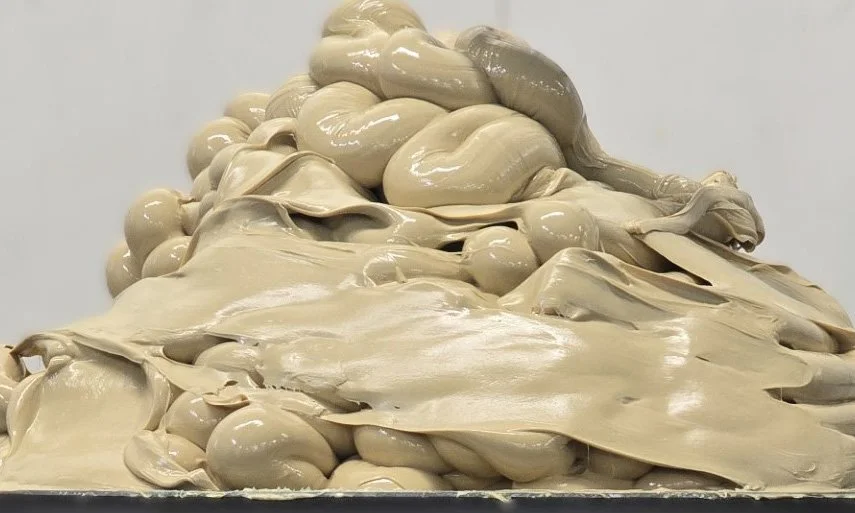
NLGI grades, established by the National Lubricating Grease Institute, measure how thick the grease feels, based on a standard cone penetration test (ASTM D217). The scale runs from 000 to 6. The lower numbers = softer, while the higher numbers – firmer.
NLGI 000 and 00 are almost pourable – typically used in centralized lube systems, enclosed gears, or extreme cold.
NLGI 0 and 1 feel like soft tomato paste. They pump well in cold weather and are great for chassis points and manual greasing in moderate conditions.
NLGI 2 is the most common – the familiar peanut-butter consistency. It stays put in wheel bearings, electric motors, and general industrial equipment.
NLGI 3 is firmer, like vegetable shortening. It’s used where bleed needs minimized, on vertical surfaces or in hotter running conditions.
Anything above NLGI 3 is specialty territory (i.e., open gears, high-temp block grease) and is rarely needed day to day.
Step 3: Select the Thickener – The Biggest Decision
Thickener drives temperature limits, water resistance, load-carrying, and compatibility. Here’s how the most common types stack up:
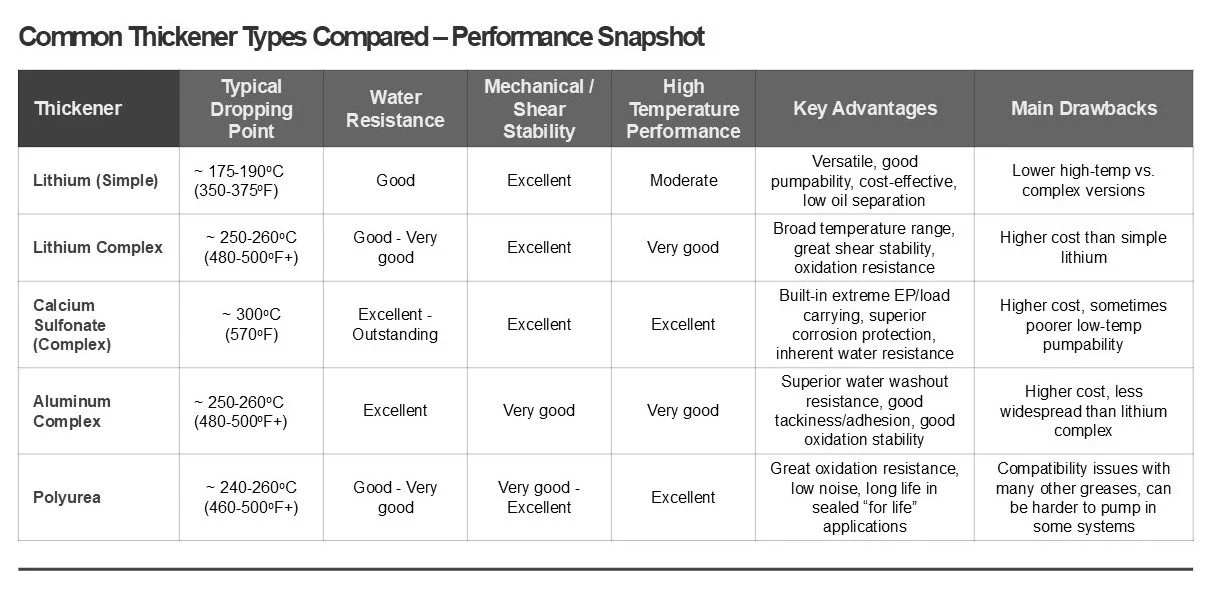
For instance, if you’re dealing with general industrial bearings under moderate loads, a simple lithium grease like our Lithium EP Plus LP-10™ Grease provides solid performance with good anti-wear properties. For higher temps and extreme pressure, step up to a lithium complex, such as Power-Lift Grease PL-10™, which holds up very well in automotive wheel bearings or pumps. And in wet, corrosive environments – like our Western Pennsylvania steel mills or coastal marine setups – calcium sulfonate complex greases shine. Our Extreme-Lift EL-10™ Grease is built for that with inherent EP and water resistance properties.
(2026 Note: Lithium supply and price volatility continue to push many plants toward calcium sulfonate complex.)
Step 4: Match Base Oil Viscosity
High speed / light load: Lower viscosity (ISO VG 32–100) for less heat and drag.
Low speed / heavy load: Higher viscosity (ISO VG 220–460+) for stronger film strength.
Low temperatures: Synthetic PAO or ester with low pour point.
High temperatures: High VI synthetic or heavier mineral.
Always check the actual base oil viscosity listed on the TDS @ 40 °C.
Step 5: Additives and Special Needs
Need shock loading? Look for high 4-ball weld load or moly.
Wet or Water washout? Calcium sulfonate or aluminum complex excel here.
Food-grade? NSF H1 certified (often aluminum or calcium sulfonate).
High temperature / long-life? Synthetic + polyurea or calcium sulfonate.
Eco-friendly? Biodegradable (i.e., ester-based formulas).
Our greases, Power-Lift PL-10™ and Lithium EP Plus LP-10™ incorporate our Metal Treatment MT-10® anti-friction lubricant additive for enhanced boundary protection. On the other hand, our Extreme-Lift EL-10™ offers built-in corrosion resistance and EP properties without needing the extras.
Step 6: Verify the Final Specs
Before you buy, confirm:
Low water-washout % for wet service.
High dropping point margins.
Pass on rust / corrosion tests in wet/salt environment.
Oil separation: Balanced – too much causes leakage; too little starves film.
Good low-temperature torque in cold climates.
Mechanical stability that won’t soften under shear.
Final Takeaway
Choosing the right grease isn’t glamorous, but it’s one of the highest-ROI things you can do. Spend ten minutes upfront matching the application to the specs, and you’ll spend a lot less time chasing down hot bearings, leaking seals, or unscheduled downtime later.
Start with the OEM callout, cross-check the TDS, and don’t be afraid to run a small test on a non-critical point if you’re switching thickener families. Your equipment — and your maintenance budget — will thank you.
Have a specific machine or operating condition you’re wrestling with? Drop us an email. Here at Muscle Products Corp., we’ve formulated options like our Lithium EP Plus LP-10™ for everyday multipurpose use, Power-Lift PL-10™ for higher demands, and Extreme-Lift EL-10™ for harsh, wet environments – all based on these same selection principles. They’re designed to help you keep things running smoothly without the guesswork.
Thanks for reading and keep that equipment running smoothly!